Request early accessEarly access

/platform

Everything your software needs, in one isolated cloud.

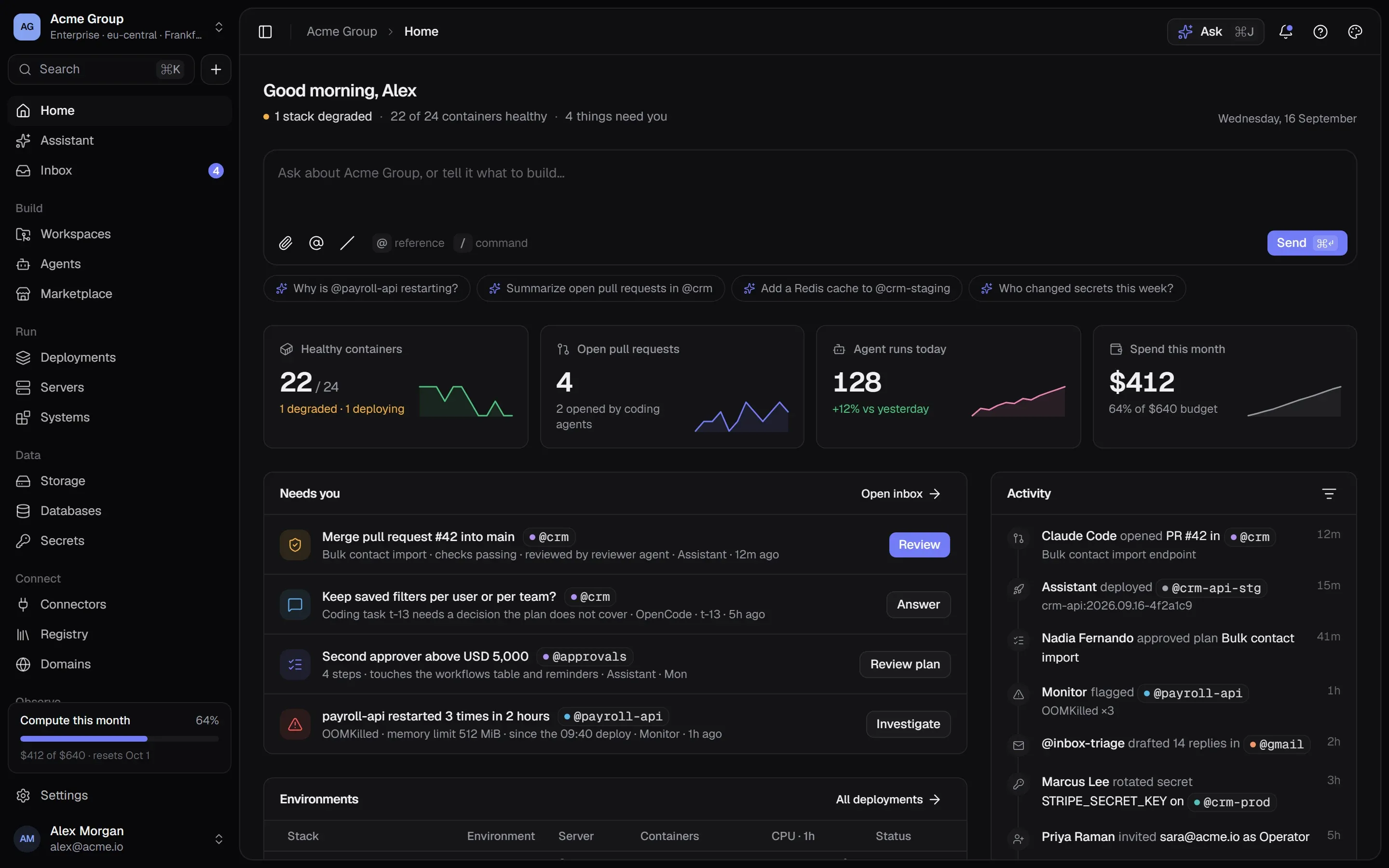
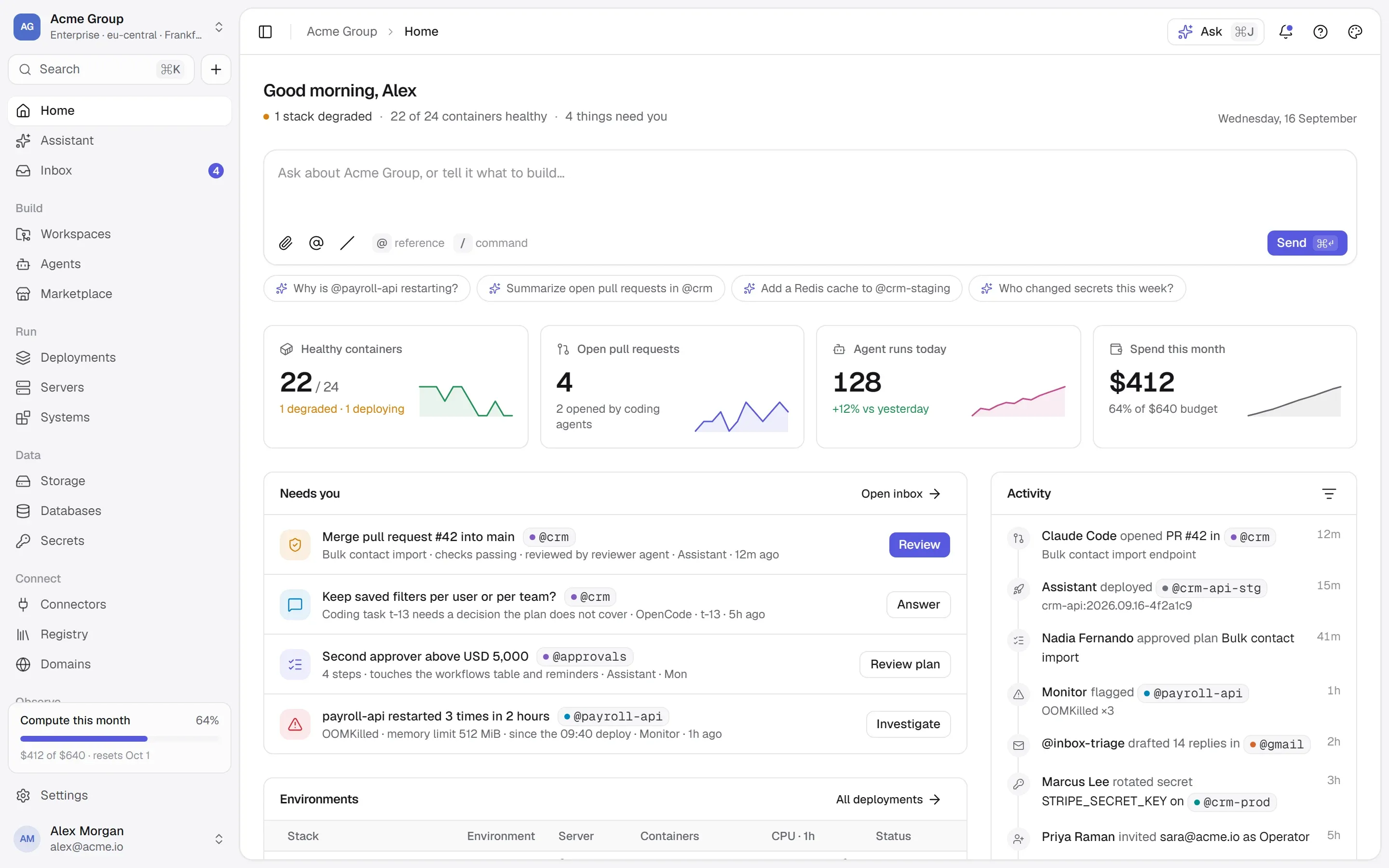
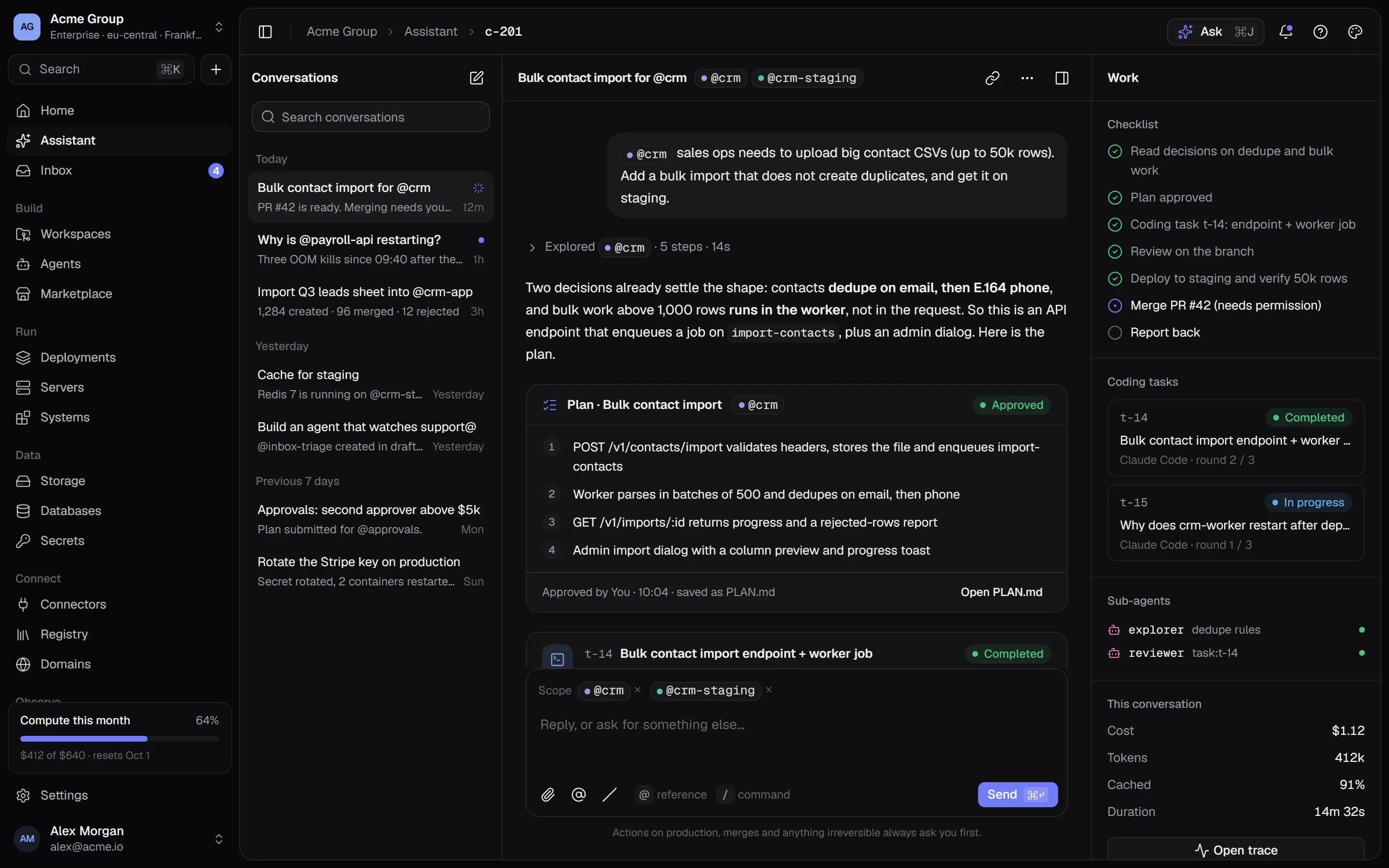
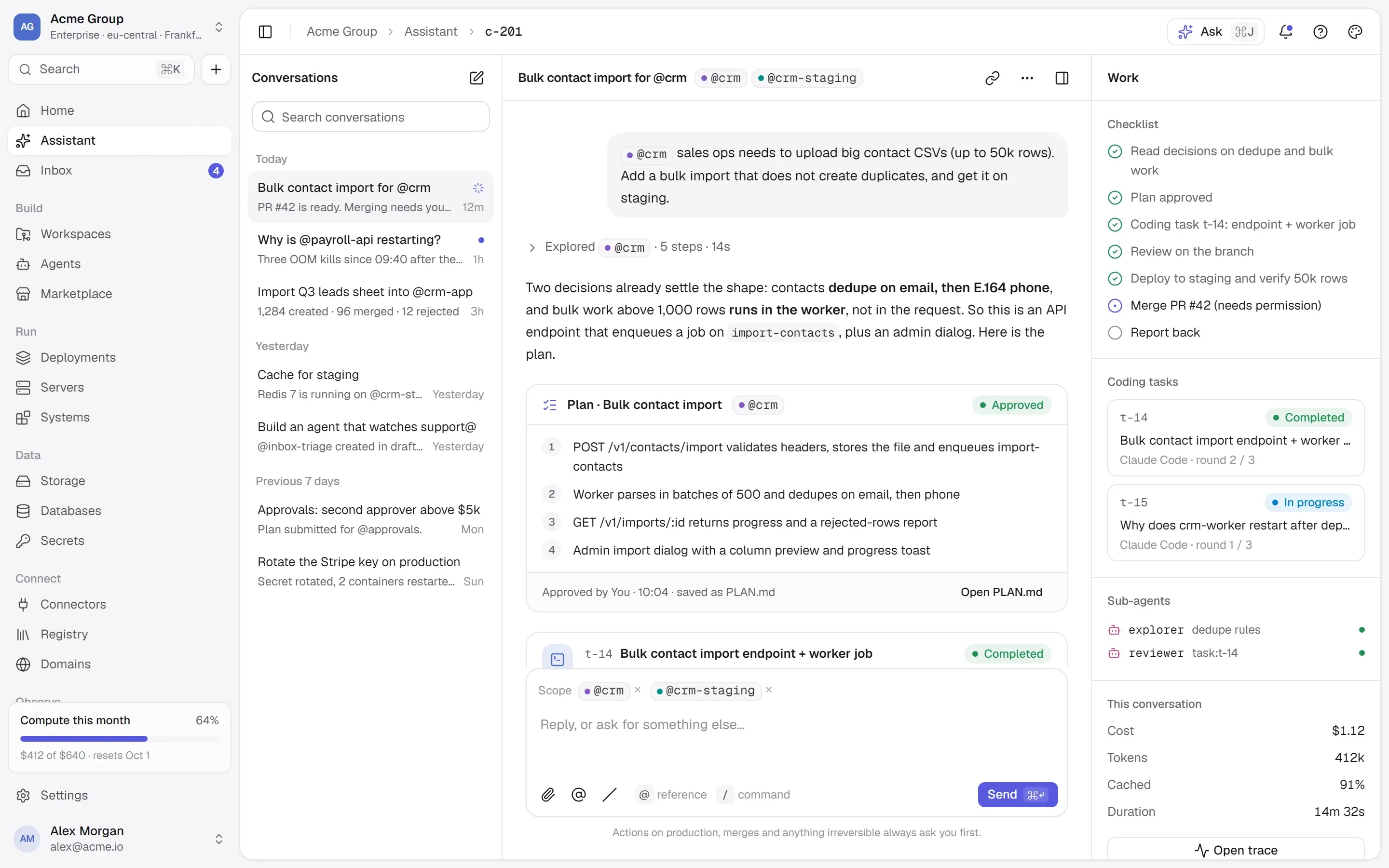
Each organization gets its own servers, networks, databases, buckets and secrets — nothing shared with anyone else. Your code comes in from GitHub, runs as containers you can reason about, and every system it becomes publishes an interface agents can use.

  • One organization, one cloud
  • Charged by the hour it runs
  • Every change on the record
another organizationanother organizationAcme Group — one isolated cloudvm-prod-1 · EU Centralcrm-prod · private networkvm-staging-1crm-stagingcrm-apicrm-admincrm-workercrm-mysqlcrm-api-stgcrm-redis-stg@crm-agent · 14 toolsacme-backups · bucketbackups/crm-mysql/a dump every 6 hoursprivate · downloads free

/areas

Four groups, one platform.

The way the product itself is arranged. Every area has its own page.

Build from your code, or from something ready-made.

Workspaces connect your repositories; the Marketplace starts you from something that works. The assistant and your own agents join here.

Run on machines that are yours alone.

Servers in our locations, stacks of containers on private networks, databases with backups, buckets and secrets.

Connect every system to what can talk to it.

A system is a product’s own interface. Its tools are discovered, tried, recorded and listed in one registry — beside the connectors to accounts elsewhere, and your own domains.

One organization, drawn the way it runs.

Servers hold stacks; stacks hold containers on a private network; a container is built from a project of a workspace, or pulled as an image; a system is the interface a product publishes; buckets and secrets sit beside them. Handles name each one — one namespace per organization — so @crm-api means exactly one thing.

  • Nothing is shared between organizations: not a machine, not a network, not a bucket.
  • People belong to organizations with a role; one person can belong to several.
  • The container and the product it adds up to are two handles, with two grants.
acme · one organization
organization   Acme Group — one isolated cloud├── server     vm-prod-1 · EU Central · Standard 2 vCPU · 4 GB│   ├── stack  crm-prod — its own private network│   │   ├── crm-api      built from @crm/api at the pushed commit│   │   ├── crm-worker   built from @crm/worker│   │   └── crm-mysql    a database · dumps into acme-backups│   └── stack  default — where a container goes unless you say├── workspace  @crm — acme/crm on GitHub · projects api, admin, worker├── system     @crm-agent — the MCP tools crm-api publishes├── bucket     acme-backups — private · downloads free└── secrets · members · teams · roles · audit log · billing # nothing here is shared with another organization

/never

What you never do here. On purpose.

  • Write Docker configuration by hand

    You choose what to run; the platform writes it — and shows you the exact commands before anything runs.

  • SSH in to deploy

    Deploys go through the platform: reviewed, health-checked, recorded, and reversible. A terminal is there when you want one.

  • Copy secrets between services

    One secret, referenced by every container that needs it; rotate it once and see who still runs the old value.

  • Pay per seat

    No platform fee and no price per person. You pay for servers, storage and what they use — by the hour.

/trust

Nothing irreversible without you.

Safety here is a set of mechanisms you can inspect, not a badge: what the platform will not do on its own, and what it writes down when it does.

How we keep it safe
  • An isolated cloud per organization

    Servers, networks, databases, buckets and secrets belong to one organization. Nothing is shared with anyone else.

  • Destructive means typed back

    A tool that changes data asks first; one that destroys it asks for its name typed back. Every call lands in a ledger.

  • Secrets never on a command line

    Encrypted and versioned, handed to a container only at deploy time — over stdin, never in a command or a log line.

  • See it before it runs

    Every create shows the exact Docker commands it will run, with secrets by name, before anything is made.

  • Deploys that can’t take you down

    The new container must pass its health check before the old one goes. If it fails, the old one is still serving.

  • Sign-in you control

    Passkeys, two-factor, single sign-on with OIDC or SAML 2.0, verified email domains — and you can require them.

/start

One cloud. Yours.

Request early access — no platform fee, no price per seat. You pay for what runs, by the hour.

Quick links

Request early accessthe way in
Platform overvieweverything in one isolated cloud
Marketplaceapps, databases, Docker Hub, MCP
Pricingplans, usage, AI credits
Securityisolation, secrets, approvals, audit
Changelogwhat shipped, newest first
Talk to ussales, help, security, privacy

Appearance

Dark mode
Light mode
System mode
Moonlight palettesilver-white · moon blue · lavender grey · the default
Signal paletteindigo · the classic
Ember paletteorange · amber · crimson
Aurum palettegold · bronze · champagne
Clay paletteterracotta · rust · sand
Mocha palettecaramel · mocha · cream
Rosewood palettedusty rose · wine · blush
Sage palettesage · eucalyptus · oat
Tide palettesea teal · deep sea · seafoam
Slate palettesteel blue · slate · mist
Dusk palettelilac · mauve · slate blue
Indigo accent
Violet accent
Blue accent
Teal accent
Emerald accent
Amber accent
Orange accent
Rose accent
Graphite accent
Cool surface
Neutral surface
Warm surface
Midnight surface
↑↓ move↵ open⌘K or / anywhere on the site