Request early accessEarly access

/assistant

One conversation that runs everything.

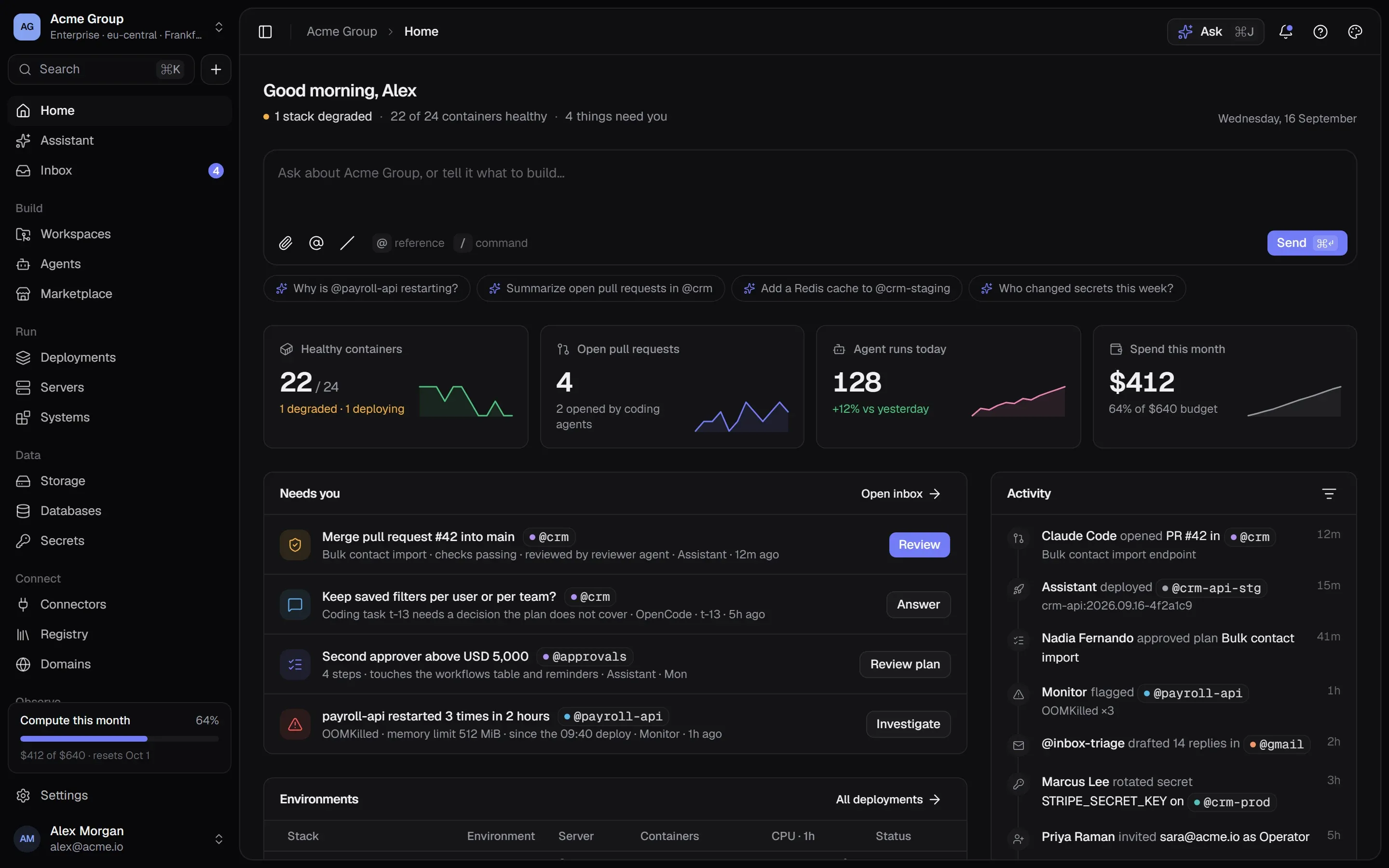
Ask about anything in your organization or tell it what to build. It reads what is running and the code behind it, writes a plan you approve, and asks before anything it cannot undo — across servers, deployments, databases, storage, secrets, workspaces and systems.

  • Plans you approve first
  • Asks before anything irreversible
  • Cost shown per conversation

An example of the Assistant at work. You ask “Add a Redis cache to @crm-staging”. It reads what is running, answers with a three-step plan, you approve it, and it reports: @crm-redis-stg is running · @crm-api-stg switched with no gap.

Assistant@acme
Request early access⌘↵

/how-it-works

Designed around what you approve.

The assistant works the platform underneath it — servers, deployments, systems, the ledger — and goes through the same checks a person does.

01

@handles and /commands.

Two ways to be specific, on purpose different. An @handle is a reference: it loads that thing’s capability card — its tools, its docs, whether a call can be undone — so the conversation carries fourteen tools instead of hundreds. A /command is a platform verb run as written, with no model involved: /deploy, /logs, /restart, /rollback.

  • A mention stays pinned to the conversation until you dismiss it.
  • / is a keystroke, @ is a conversation.
  • An unknown handle never fails silently — it answers with the nearest three.
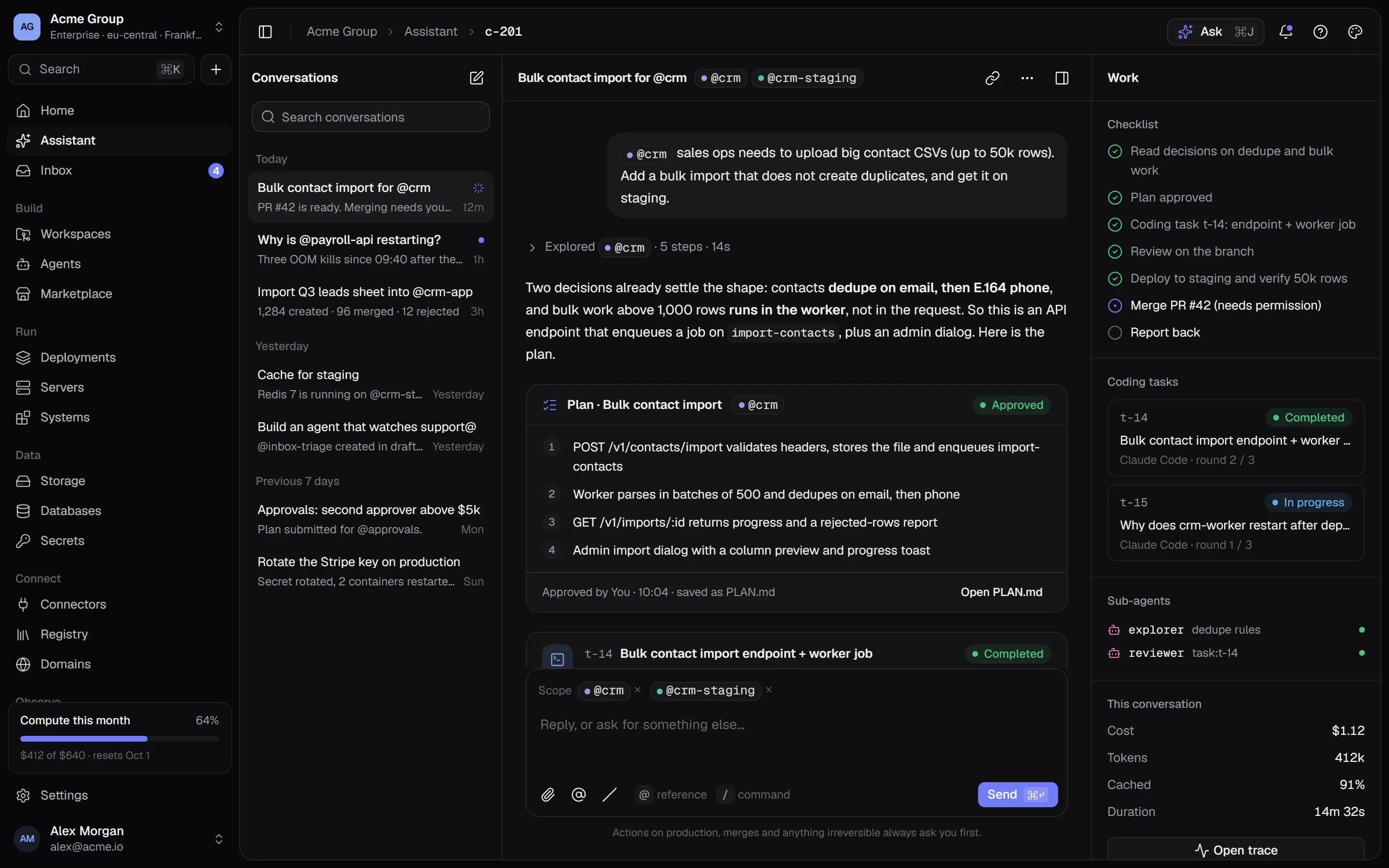
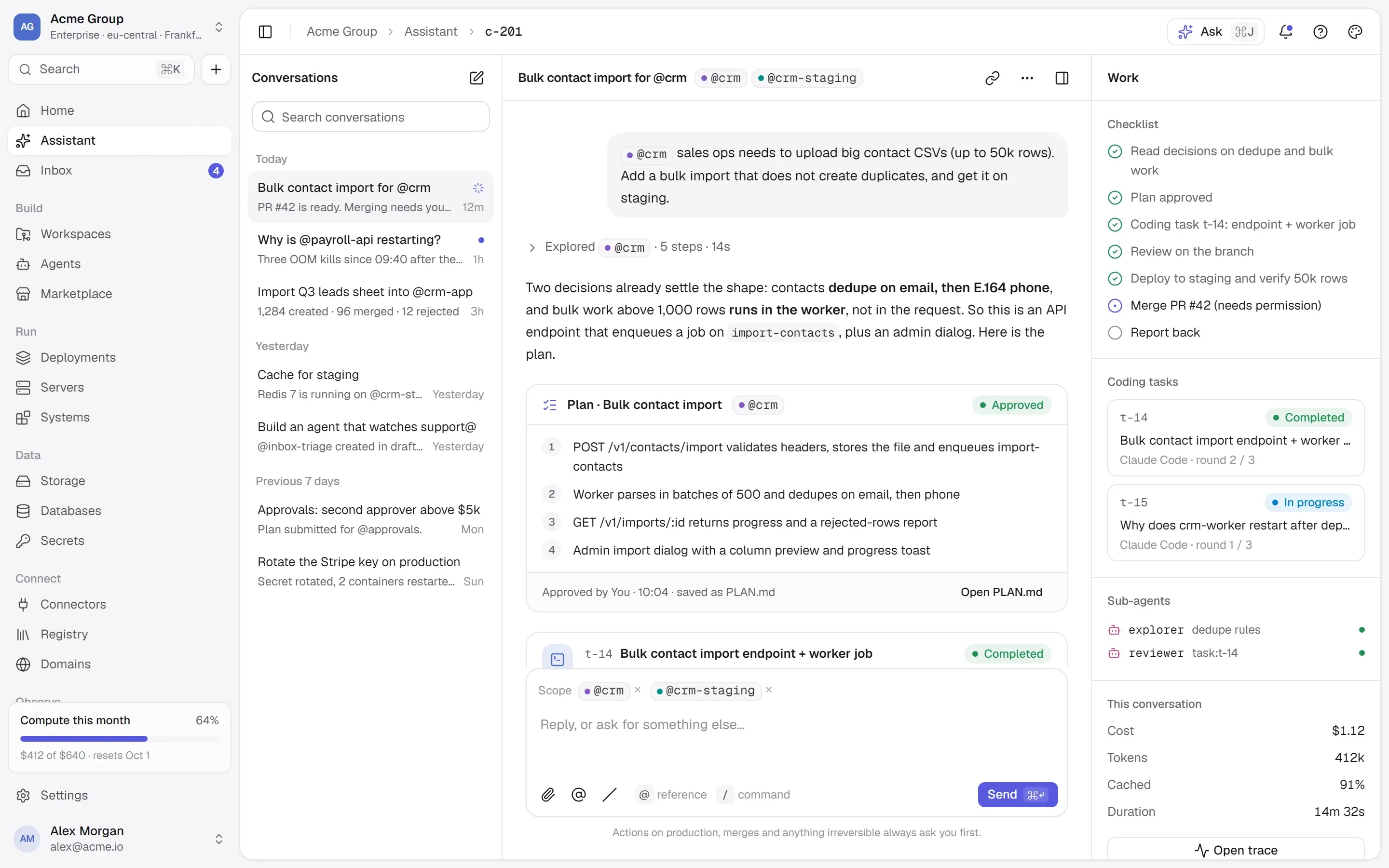
The Assistant: a conversation about a bulk contact import, with an approved plan, coding tasks, sub-agents, a checklist and the conversation’s cost.The Assistant: a conversation about a bulk contact import, with an approved plan, coding tasks, sub-agents, a checklist and the conversation’s cost.

02

Plans you approve before work starts.

Software work starts from a plan: yours, checked into the house PLAN.md shape, or one written for you from the code and what is running. Nothing is built until you approve it. Then a coding agent works in a sandbox from the workspace — its code, its documents, its skills and rules — with tests and review before a pull request.

  • The plan is a file in the repository, versioned with the code.
  • Coding tasks run in isolated sandboxes, discarded when they fail.
  • The result is a pull request with the rounds, the cost and the branch.
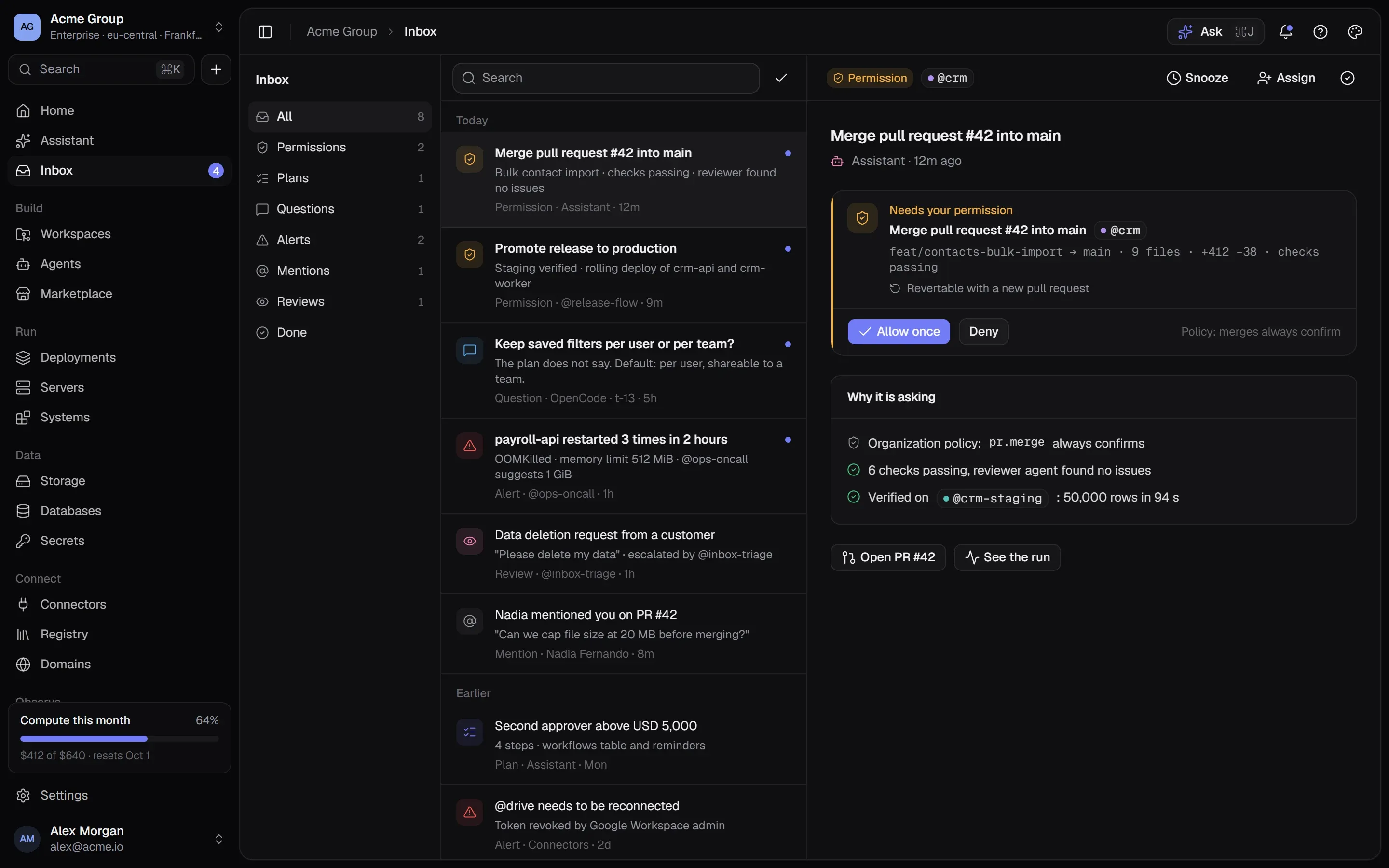
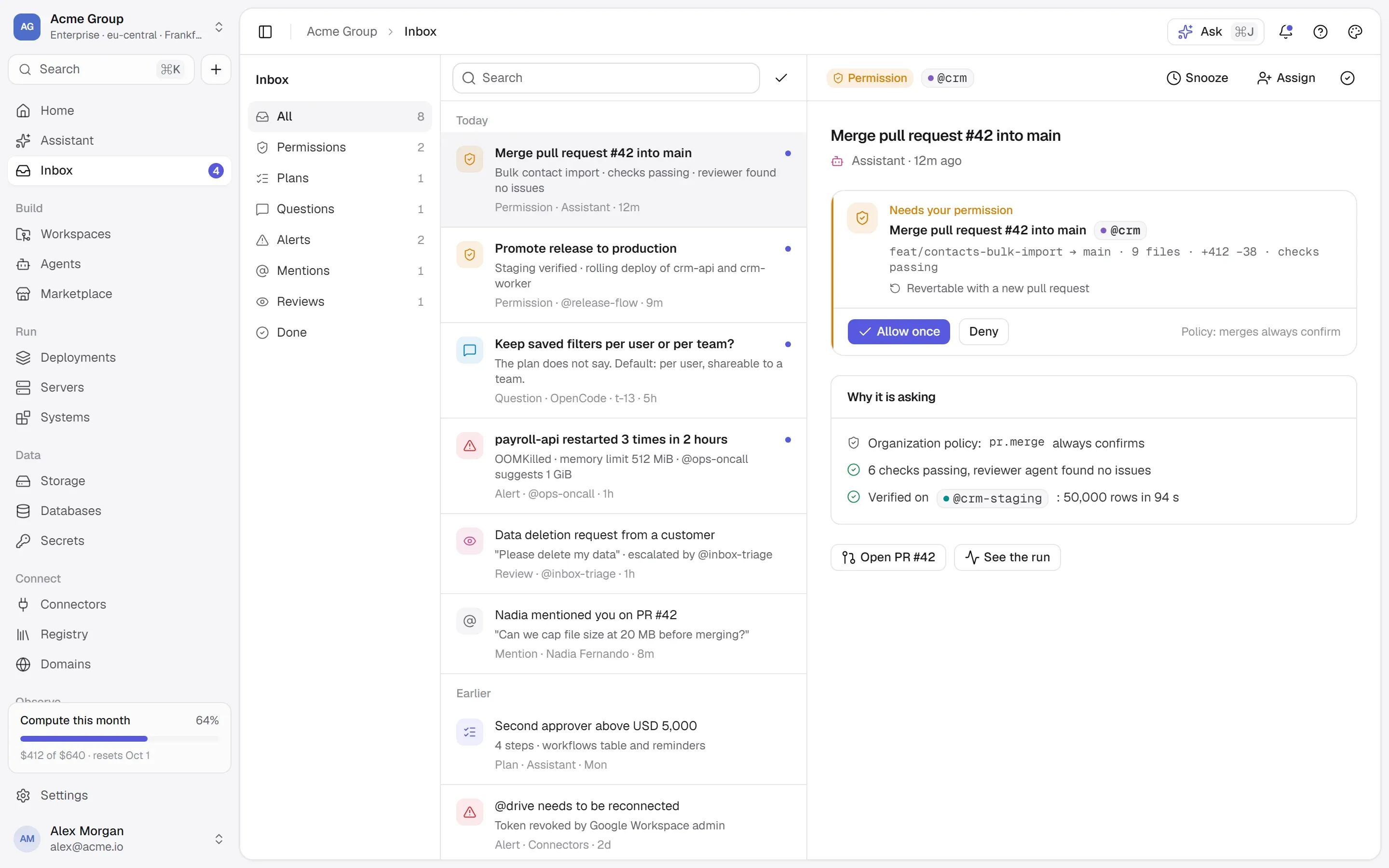
The Inbox: permission requests, plan approvals and questions from agents, waiting for a person.The Inbox: permission requests, plan approvals and questions from agents, waiting for a person.

03

Questions climb a ladder.

A coding agent never interrupts you directly. It asks the agent that assigned the work, which answers from the plan and the repository; then the assistant, from what it knows of your standards; and only then you — with one question, two or three options and a default. The answer is written back into the plan.

  • You are the last rung, not the first.
  • One question, a few options and a default — never an open-ended “what should I do?”.
  • Every answer ends up in the plan, so it is asked once.

04

Asks before anything it cannot undo.

Every action goes through the same gate the console uses: a read runs, a write is confirmed, and anything that cannot be undone asks for its name typed back. A request above your own permissions becomes an approval — a card in the conversation and in the Inbox — for someone who holds them.

  • The assistant can never do what the person in the conversation cannot.
  • Approvals wait in the Inbox of the people who may decide them.
  • Every call lands in the same ledger as a person’s.
@crm-agent · callsrecorded before each call
  1. 09:43:30companies.getread{ id: "co_12" }200 · 9 ms
  2. 09:43:02contacts.mergedestructive{ keep: "c_88", merge: ["c_91"] }name typed back · 240 ms
  3. 09:42:40webhooks.createexternal{ url: "https://…", secret: [redacted] }confirmed · 96 ms
  4. 09:42:05deals.updatewrite{ id: "d_1042", stage: "won" }confirmed · 180 ms
  5. 09:41:30contacts.bulk_upsertwrite{ rows: [1,380], dedupe_on: "email" }confirmed · 2.1 s
  6. 09:41:12contacts.searchread{ q: "acme", limit: 20 }200 · 14 ms

05

What every conversation costs.

The assistant runs on prepaid AI credits, so it is never billed after the fact. Each conversation shows what it has cost; when credits run out, calls are refused and the conversation says so, linking to Billing. Automatic top-up keeps a balance if you want one.

  • Credits are bought in packs or a custom amount, in Billing.
  • New organizations start with welcome credits.
  • Per-run and per-day caps for agents, under the organization’s own.

/faq

The assistant, answered plainly.

Something else? Write to [email protected] or use the contact page — a person answers.

What can it work on?

Everything in your organization: servers, deployments, databases, storage, secrets, workspaces, systems and the ledger — and everything it does goes through the same checks you can try by hand.

Which models does it use?

The model behind each part of the work is chosen for the job. Every call is paid from your prepaid credits, priced as it is made.

Can it change production without me?

No. It can only do what the person in the conversation may do, and anything that writes asks first; anything that cannot be undone asks for its name typed back. Work above your permissions becomes an approval for someone who has them.

Where does it run code?

In isolated sandboxes, booted from your workspace and discarded afterwards. What ships is a pull request, then a deploy — health-checked like any other.

/start

Ask for what you need.

Request early access — tell us what you would like it to build first.

Quick links

Request early accessthe way in
Platform overvieweverything in one isolated cloud
Marketplaceapps, databases, Docker Hub, MCP
Pricingplans, usage, AI credits
Securityisolation, secrets, approvals, audit
Changelogwhat shipped, newest first
Talk to ussales, help, security, privacy

Appearance

Dark mode
Light mode
System mode
Moonlight palettesilver-white · moon blue · lavender grey · the default
Signal paletteindigo · the classic
Ember paletteorange · amber · crimson
Aurum palettegold · bronze · champagne
Clay paletteterracotta · rust · sand
Mocha palettecaramel · mocha · cream
Rosewood palettedusty rose · wine · blush
Sage palettesage · eucalyptus · oat
Tide palettesea teal · deep sea · seafoam
Slate palettesteel blue · slate · mist
Dusk palettelilac · mauve · slate blue
Indigo accent
Violet accent
Blue accent
Teal accent
Emerald accent
Amber accent
Orange accent
Rose accent
Graphite accent
Cool surface
Neutral surface
Warm surface
Midnight surface
↑↓ move↵ open⌘K or / anywhere on the site